Last updated:
The basic tax rules for crypto assets, including the holding period and exemption thresholds, are set out in our guide Crypto Tax Advisor.
Comparison: precious metals versus cryptocurrencies from a tax perspective (Germany 2026)
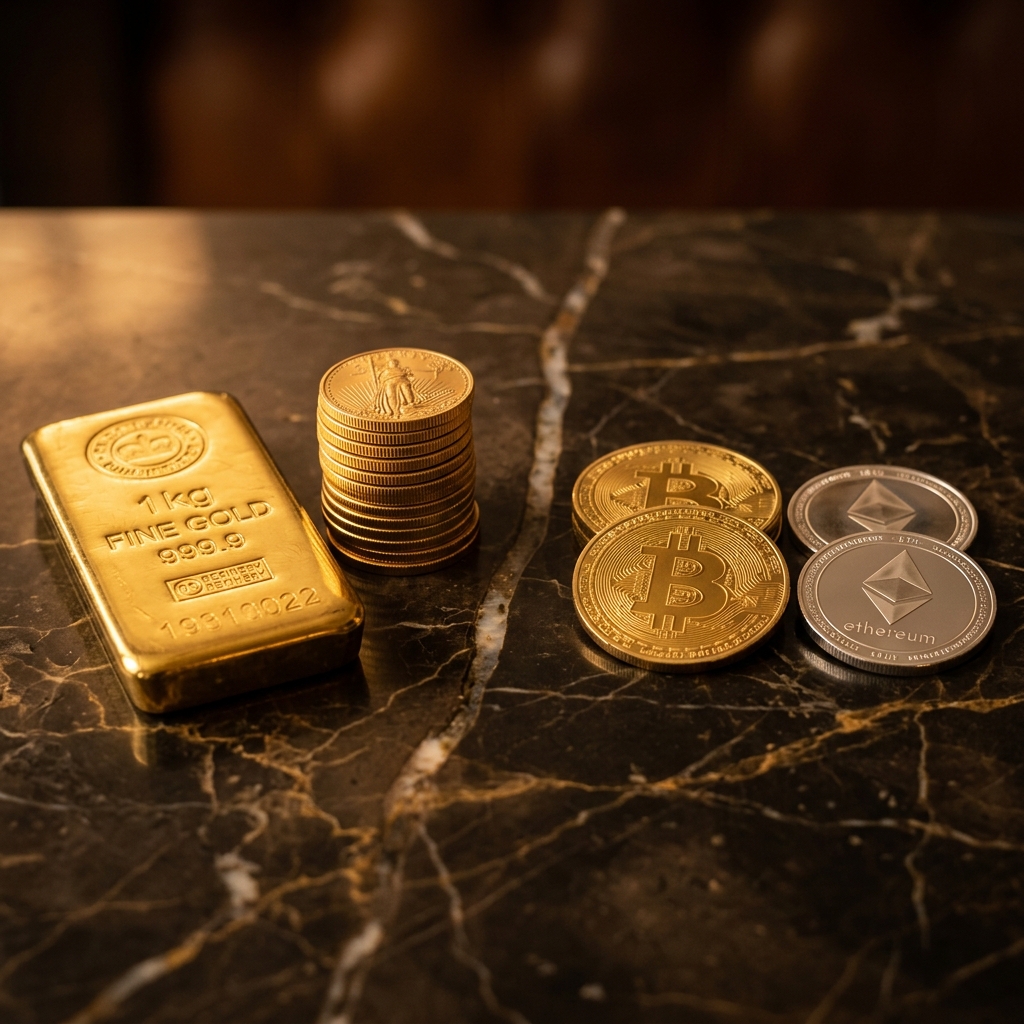
What can the two asset classes crypto and precious metals have in common? At first glance only differences come to mind. The most obvious: one is physical and tangible. I hold something in my hand and understand it at once. The other? Digital, without a thousand-year history and not immediately comprehensible. But if we look at the two asset classes in German tax law, we find a number of parallels.
The tax compass shows when investments are taxed tax-free, individually or at a flat rate, depending on the holding period and product structure. In this article we want to delve into the depths of German tax law and find out how precious metals (gold, silver, copper and so on) and cryptocurrencies (Bitcoin, Ethereum, Solana) fare in their taxation.
The focus is on different forms of investment, from physical acquisition through spot trading and derivatives (ETCs/ETPs) to futures and leveraged products, as well as the respective tax consequences, such as holding periods, taxation of gains, loss offsetting, withholding tax, the speculation period and questions of commerciality.
Beyond that, strategic considerations for short, medium and long-term investment horizons are examined from the perspective of private investors. Please note that only the current position for the year 2026 is reflected in this article. Tax law in Germany develops constantly, so statements made here may be superseded in future.
Tax foundations:
Private disposal transactions
Physical precious metals (for example gold, silver, copper) and cryptocurrencies acquired directly (spot trading) generally fall under private asset management, provided they are not allocated to business assets. For you this means: a purchase and sale within one year falls in these cases under disposal transactions treated in accordance with Section 23 (1) no. 2 EStG.
1. Speculation period of one year:
A holding period of one year applies to these economic assets:
Example: if a gold bar or Bitcoin is held for longer than one year, the disposal gain remains „tax-free“.
2. Exemption threshold of 1,000 EUR (since 2023)
Since 2023 the exemption threshold has been 1,000 EUR per calendar year (previously 600 EUR):
3. Taxation at the personal tax rate
Taxable gains (within the one-year period and above the exemption threshold) are subject to the personal income tax rate:
4. Loss offsetting
Losses from private disposal transactions:
Important: the one-year holding period applies to both gains and losses.
This means: both gains and losses are irrelevant for the tax return after a holding period of more than one year. In the case of gains we are pleased about this; with losses, by contrast, it can become financially unpleasant.
Tip: particularly with altcoins and memecoins, losses should be realised before the holding period expires. So check your holdings and holding periods regularly.
No extension of the holding period for cryptocurrencies
For certain economic assets, Section 23 EStG provides for an extension of the speculation period to ten years where ongoing income is generated from them (for example letting in the case of real estate).
With cryptocurrencies there was uncertainty for a time as to whether lending or staking could trigger such an extension. The BMF circular of 6 March 2025 clarified, however:
Nevertheless, in my view caution is called for here. The statement made by the tax administration in its BMF circular may be overturned in future by a court decision.
With physical precious metals this issue regularly does not arise, since they generate no ongoing income.
Delimitation: income from capital assets (Section 20 EStG)
As an investor you have surely heard of income from capital assets. This classically includes income from shares, ETFs, interest and so on. On the financial markets, however, there are many further products that can be traded and that likewise fall under income from capital assets, even where gold or Bitcoin is written on the „packaging“. Different tax rules apply here: in particular the withholding tax of 25% (plus solidarity surcharge and where applicable church tax) on price gains, irrespective of holding periods.
This category includes in particular structured products, exchange-traded derivatives, certain ETP/ETC constructions and other financial instruments with the character of securities.
Different tax principles apply here:
Tax differences examined in detail
In the following we explain the above categories once more with their particular features and address differences and similarities between precious metals and cryptocurrencies, including tax consequences and legal bases:
1. Physical acquisition and sale (direct investment)
Physical precious metals (bars, coins):
Let us start with the classic case. If a private investor buys a gold bar or silver coins, for example, they acquire a tangible asset as private property. Gold, silver and so on can be bought not only „over the counter“ from a dealer but also on precious metal exchanges or traded online. The spot price is the current rate on the market. If you buy 100 g of gold via an online platform, for example, and have it stored in a high-security vault, that is effectively spot trading. For tax purposes this makes no difference compared with physical possession: what is decisive is that you become the owner of the gold. Whether you have it sent to your home or leave it in storage is irrelevant. Platforms do not deduct withholding tax, precisely because these are not investment income but potentially tax-free disposals; responsibility for declaring them in the tax return lies with the investor, just as if they privately sold a gold bar.
Note: with some precious metal brokers, gold and silver can also be traded in the form of „spot contracts“ without storage, which with cash settlement are more like financial products. Such cases are, however, rare in the retail business; as a rule you acquire actual precious metal (where applicable securitised).
The purchase itself does not yet constitute a taxable event. A transaction only becomes relevant for tax on the sale (or exchange) of the item. What is then decisive is the holding period:
This rule, anchored in law in Section 23 (1) no. 2 EStG, makes physical gold attractive: long-term investors can realise increases in value completely tax-free.
Example: purchase of a Krugerrand gold coin in 2020 for 1,500 EUR, sale in 2026 for 3,800 EUR. The 2,300 EUR gain remains tax-free (holding period more than 1 year).
The gain is taxable at the personal income tax rate.
Or
Does the exemption threshold of 1,000 EUR apply?
If the total gain from all private disposals of the year stays below 1,000 EUR, no tax arises. If the threshold is exceeded, the entire gain must be declared. (Until 2022 this threshold was 600 EUR.)
Example: in 2025 a sale of gold after 6 months with a loss of 2,000 EUR, and at the same time the sale of a classic car with a gain of 4,000 EUR. The gold loss reduces the taxable classic car gain, so that only 2,000 EUR remains as a private disposal gain.
Cryptocurrencies (direct purchase and wallet):
From a tax perspective, Bitcoin and the like held as private assets behave very similarly to precious metals. The tax office regards individual crypto coins as „other economic assets“ and therefore likewise as objects of private disposal transactions (Section 23 EStG as well).
In most cases the private investor invests through so-called spot trading on crypto exchanges (such as Coinbase, Kraken, Binance and so on). You exchange fiat money (for example EUR) for crypto coins or exchange different coins for one another. Here you directly acquire ownership of the coins (or securitise a claim to them until you have them paid out). The trading platform typically does not deduct tax, since it does not act as a domestic custodian bank. It is up to the investor to record their trades completely. Some German providers (for example Bison, Trade Republic and so on) make tax reports available at the end of the year, but there too no automatic tax deduction takes place on the sale of crypto, because it is precisely not investment income within the meaning of the law but a private disposal transaction.
Important: in the crypto sphere it is common to switch between coins even at very short notice. Each of these trades restarts the holding period. Example: an investor buys Bitcoin in January, exchanges into Ethereum in April and back into Bitcoin in August. Here they have two disposal transactions within one year (BTC to ETH, and ETH to BTC), both of which can be relevant for tax. Even if they hold Bitcoin again at the end, the original acquisition time has been cut off by the intermediate disposal.
Strategy tip: short-term oriented crypto traders therefore have to consider the tax consequences of every trade, while long-term oriented „buy and hold“ investors have less complexity.
For tax purposes:
The gain is tax-free, exactly as with gold. Many crypto investors use this rule deliberately: so-called „HODLing“ for at least one year in order to take price gains tax-free. This was also confirmed by the Federal Fiscal Court (BFH).
The gain is taxable (provided the annual total gain from Section 23 transactions exceeds 1,000 EUR). Important: every exchange of one cryptocurrency into another or into fiat money counts as a disposal.
Example: anyone who buys Ethereum in April and switches into Bitcoin in October has disposed of Ethereum; a gain realised in the process would be taxable within the speculation period.
CAUTION: using cryptocurrency to buy goods or services is also treated for tax purposes as a sale of the coin at market value (which can lead to a taxable gain).
Key similarity:
Spot and direct transactions lead to the same tax result for both asset classes as ownership of the physical good. With both privately held physical precious metals and privately held cryptocurrencies there is the possibility of avoiding tax through a holding period of more than one year. This tax exemption after the speculation period makes both interesting long-term investments. By contrast, shares, for example, have always been taxable since 2009 (withholding tax), however long they are held. Here, then, gold and Bitcoin have a similar advantage from a German tax perspective that you can use strategically as a long-term investor.
Differences:
Some practical differences should nevertheless be mentioned:
– Gold as investment gold is usually sold free of VAT (provided bars have a minimum fineness of 995/1000 or are recognised investment coins, in accordance with EU Directive 98/80/EC).
– Silver, platinum and palladium, for example, are in principle subject to the full 19 % VAT on purchase. Exceptions can apply where they are collector coins or „used“ coins.
– Cryptocurrencies, by contrast, can be acquired free of VAT. This was confirmed in 2015 by the European Court of Justice in the Hedqvist judgment. For VAT purposes they are to be treated like the exchange of legal currencies. For tax purposes this is an advantage for crypto over silver and platinum, since the latter first have to overcome the VAT hurdle (which can only be circumvented through special arrangements such as bonded warehouses).
In practice, crypto transactions are often more numerous and more complex (trades on exchanges, wallet transfers, forks and so on), which makes documentation for tax demanding. Investors must keep complete evidence of acquisition dates and costs in order to determine the holding period and gains correctly in the event of a disposal. The BMF circular 2025 emphasises the tightened documentation obligations for crypto assets.
With physical precious metals, providing evidence is usually simpler (invoices on purchase, sales receipts), and the transaction frequency is typically lower.
For tax purposes it remains a private acquisition and disposal. What is decisive is the form of ownership: if you hold the asset yourself as private property, Section 23 EStG applies.
Only when the form of ownership changes, for example if you do not buy gold yourself but a certificate, or do not hold Bitcoin yourself but a security based on it, do you leave this area. That brings us to the derivative forms of investment.
3. Derivatives: ETCs, ETPs, certificates and funds
The term derivatives is used here in a broad sense for all derived financial products that relate to precious metal or crypto prices but where the investor does not directly own the asset itself.
These include exchange-traded products such as ETCs/ETNs, ETFs, certificates and the like. These products can be treated differently for tax purposes depending on how they are constructed.
Precious metal ETCs and funds:
Legally these are bearer bonds that securitise the claim to receive a certain quantity of gold. They are therefore backed by physical gold and the issuer actually stores the metal. An investor can normally have the gold delivered on request (instead of selling the bond). The Federal Fiscal Court decided in a leading judgment that such constructions are to be treated for tax purposes like directly holding gold. Specifically: disposal gains from Xetra-Gold and the like are tax-free after 1 year, exactly as with coins or bars. This judgment (BFH of 6 February 2018, case no. IX R 33/17) removed earlier doubts. The finance ministry followed it and likewise exempted other physically backed gold ETCs.
Caution: redeeming an ETC (that is, exchanging it for real gold within one year) is likewise not a taxable transaction according to the BFH, because the investor is not selling but exchanging their securitised right for the physical good. No investment income can be constructed from this either. Only when you finally sell the gold does Section 23 EStG apply again. This clarification prevents investors from being disadvantaged for tax purposes by taking delivery.
An ETF on gold is as a rule not an ETC but an investment fund that invests, for example, in gold derivatives or in shares of gold mines. Here the investor holds fund units, that is, securities.
Since 2009, gains from the sale of such fund units have been subject to withholding tax (25%); there is no speculation period.
Example: if someone sells units of a silver ETF at a profit, the bank deducts 25% withholding tax (provided it is a German broker). A physically backed gold ETC is better for tax purposes (tax-free after 1 year) than a gold ETF that holds futures, for example (permanently taxable). Shares in gold and silver mines or commodity companies are likewise subject to normal withholding tax on sale. Although indirectly dependent on the gold price, they are shares that fall under Section 20 EStG.
Conclusion on precious metals:
If a tax-free increase in value is the goal, you should choose physical metal or at least physically backed bonds (ETCs). Paper gold without a claim to delivery, by contrast, is treated like a normal capital investment (25% tax on gains). As you may have noticed, there is a good deal to bear in mind, and depending on the derivative purchased, different tax consequences can arise. So check carefully beforehand which product you are acquiring.
Crypto ETPs and certificates:
As with gold, the market has also produced exchange-traded crypto products, often described as ETNs/ETPs (exchange traded notes/products). Examples:
BTCetc – Physical Bitcoin,
ETHetc – Physical Ethereum
As with gold, what matters is whether the product is physically backed and deliverable. The BMF circular of 06.03.2025 confirms that crypto ETPs with a claim to delivery of the coins are to be treated for tax purposes like direct coins.
Specifically: the gain is tax-free after 1 year, taxable within 1 year, and no withholding tax is levied, because Section 23 EStG applies. The custodian bank shows such trades separately in the tax certificate (usually as a „Section 23 loss/gain“).
In practice: initially some banks incorrectly treated these products like shares (25% tax) but then changed their approach after the BMF circular appeared. For investors this means: such ETPs offer the same tax advantage as directly holding Bitcoin but can be conveniently traded in a securities account.
Crypto certificates without physical backing: these include, for example, certificates that only give a claim to cash settlement or where no genuine coin backing takes place.
These products count as investment income. Their gain is always taxable (25%), however long you hold. The bank treats them like a normal security: tax is withheld automatically.
Example:
The Bitcoin ETN from VanEck (ISIN DE000A28M8D0) is physically secured and also allows (theoretically) delivery; accordingly it would be treated under Section 23. Another product without this feature would be taxed differently. Investors should therefore check in advance:
Does my crypto ETP offer physical backing with the possibility of delivery?
If yes, it is advantageous for tax (use the holding period).
If no, it may be subject to withholding tax, which can, however, also have an advantage (namely loss offsetting in the securities pot, see strategic considerations).
4. Futures, CFDs and other leveraged products
Leveraged products make it possible to speculate on price movements without fully owning the asset. Examples: futures contracts, options, CFDs (contracts for difference), warrants or leveraged certificates. Here you usually buy a financial instrument whose value depends on the underlying, often with a short term. For tax purposes we almost always end up in the area of Section 20 EStG (investment income), since these are forward transactions, not direct ownership of the economic asset.
Loss offsetting used to be restricted (Section 20 (6) sentence 5 EStG, old version), which meant that you could offset a maximum of 20,000 EUR of forward transaction losses against gains per year. Anything beyond that was carried forward into subsequent years. This rule hit active CFD traders hard, for example. After criticism and an indication from the BFH, the legislator overturned this limit retrospectively. Now you can offset forward transaction losses against gains without limit (but still only within the category of forward transactions).
Example: in 2025 an investor makes 50,000 EUR of gains from gold futures and 30,000 EUR of losses from oil futures. Previously they would not have been allowed to set off 10,000 EUR of the loss; now they can deduct the full loss and tax only 20,000 EUR of net gain. For private investors precious metal futures are more of a special case. Anyone wanting to bet on precious metals directly with leverage often uses CFDs or certificates through their securities account. These are subject to the same principle: gains equal 25% tax, losses offsettable within the framework of forward transactions.
The 20,000 EUR loss rule technically applied to crypto forward contracts as well and has likewise been abolished.
Note: some investors might think that crypto futures fall under Section 23 EStG because the underlying crypto is an economic asset. That is not the case; what is decisive is the financial and derivative character of the instrument. For tax purposes it is classified as a forward transaction.
The interest expense for the credit could be claimed as income-related expenses under Section 23 (which, however, does not work, since Section 23 does not permit loss offsetting beyond the net results; in practice financing costs generally remain irrelevant except in a business). Many crypto margin trades are, however, de facto CFDs or futures, even if the platform calls it „margin trade“: you deposit collateral and bet on the price without receiving the coins. That then corresponds again to the derivative rules (withholding tax). Investors should therefore check whether, in a leveraged crypto trade, they are really buying coins (then Section 23 applies) or trading a derivative contract (then Section 20).
Summary overview:
| Form of investment | Precious metals | Cryptocurrencies |
| — | — | — |
| Physical purchase/sale (private ownership, for example bars/coins or coins in your own wallet) | Private assets (Section 23 EStG): gains tax-free after a holding period of 1 year, taxable before that (personal tax rate). Exemption threshold 1,000 EUR per year for all private disposal gains together.
VAT: the purchase of investment gold is free of VAT; silver, platinum and so on are subject to 19% VAT (exception: margin taxation or bonded warehouses can save VAT).
Losses: losses realised within 1 year can be offset against other private disposal gains of the same year (no carry-over into other types of income). After more than 1 year any losses are irrelevant for tax. | Private assets (Section 23 EStG): gains tax-free after a holding period of 1 year, taxable before that (personal tax rate). The exemption threshold of 1,000 EUR per year applies here too.
VAT: no VAT on the purchase or exchange of cryptocurrencies (as means of payment, cryptos are exempt from VAT).
Exchange/payment: exchanging one cryptocurrency for another or using it to buy goods counts for tax purposes as a disposal (measured by the market value of what is received). |
| Spot trading (exchange trading at the current rate, immediate delivery/transfer) | Spot purchase/sale, for example via precious metal dealers or an exchange, equals immediate transfer of ownership. For tax purposes this corresponds to physical acquisition. The same rules as above (1-year period, personal taxation within 1 year). No difference whether the sale is to a dealer or privately gold.de.
Example: buying gold via an online broker and having it stored counts as physical possession (for tax purposes a private disposal transaction). | Spot trading on crypto exchanges (for example purchase/sale via an exchange) equals direct trading in coins. For tax purposes identical to a direct wallet purchase. Gains tax-free after more than 1 year, otherwise income tax.
Caution: crypto-to-crypto trades on exchanges (exchanging one coin for another) also trigger a disposal for tax purposes. |
| Purchase of derivatives (for example ETCs, ETPs, certificates, fund units) | Physically backed precious metal ETCs (exchange traded commodities with a claim to delivery, for example Xetra-Gold, Euwax Gold II): following the BFH judgment of 2018, such bearer bonds are to be treated for tax purposes like physical gold. Gains after more than 1 year are tax-free, by analogy with bars and coins. This judgment (case no. IX R 33/17) ended uncertainty and has been adopted in practice.
Precious metal ETFs/funds (without a claim to delivery): here Section 20 EStG investment income applies; disposal gains are subject to withholding tax (25%), irrespective of the holding period. There is no tax exemption after 1 year. The bank generally deducts 25% capital gains tax (plus solidarity surcharge and church tax) automatically.
Example: selling units in a gold ETF or a gold mining equity fund always triggers withholding tax (loss offsetting possible in accordance with the rules for shares and funds). | Physically secured crypto ETPs (exchange traded products with full backing and the option of delivery of Bitcoin and the like): according to the BMF circular of 10.05.2022 (supplemented in 2025), such products are treated like direct investments in cryptocurrency. Speculation period 1 year: gains after the holding period are tax-free, taxable within 1 year (personal tax rate), by analogy with Section 23 EStG. No withholding tax; investors may have to declare gains themselves in their tax return. Example: the ETC Group Physical Bitcoin (WKN A27Z30) is fully backed with Bitcoin and deliverable; the BMF clarified that sales are not subject to 25% taxation but are tax-free after 1 year.
Crypto ETPs without a claim to delivery (for example certificates, structured products without physical backing): these are not classified as a private disposal transaction but as investment income. Disposal gains are subject to capital gains tax of 25%, irrespective of the holding period. The bank deducts the tax, and the usual loss offsetting in the securities area applies. Note: whether a crypto ETP falls under Section 23 EStG (speculation period) or Section 20 EStG (capital gains tax) depends on the product design. Products are marked accordingly in the securities statement (Scalable Capital indicates in the statement whether an ETP falls „under Section 23 EStG“). |
| Futures, margin trading and leveraged products | Forward transactions on precious metals (for example gold futures, commodity exchange contracts, CFDs on the silver price, warrants with leverage on the gold price): for tax purposes these count as financial instruments (Section 20 EStG), not as physical metal sales. Gains are subject to withholding tax (25%); there is no holding period, so every realised gain is taxable in the year of realisation.
Loss offsetting: losses from such forward transactions were until recently offsettable only up to 20,000 EUR per year (Section 20 (6) EStG old version). This contested restriction was, however, abolished by the Annual Tax Act 2024 (retrospectively for open cases). Now losses from forward transactions can be offset without restriction against gains from the same category. (Losses from forward transactions can, however, only be offset against gains from other forward transactions, not against share gains or Section 23 gains, for example.)
Example: gains from trading gold futures on the exchange are taxed at 25%. A loss from a silver CFD can be fully offset against a gain from a gold future in the same year (since the abolition of the 20k limit). | Crypto futures and options (for example Bitcoin futures on the exchange, Ether perpetuals on platforms, margin trading/CFDs on cryptocurrency prices): these are treated for tax purposes like other financial forward transactions. No holding period exemption; realised gains are always taxable and to be taxed at 25% withholding tax (plus solidarity surcharge and church tax), provided they are traded as private assets.
Here too the 20,000 EUR loss offsetting limit applied until 2023, which fortunately for investors has been dropped since 2024. Losses from crypto futures can now be fully offset against other forward transaction gains (including from share options, for example).
Note: crypto margin trading on foreign exchanges (for example futures at Binance) also falls under these rules in Germany, but foreign platforms do not deduct tax. Gains must be declared by the investor. German brokers, by contrast, automatically withhold withholding tax on forward transactions. |
Commerciality: with both precious metals and cryptocurrencies, certain circumstances can lead to private asset management being exceeded and the tax office assuming commercial trading. As a rule, however, more circumstances must be present than merely the volume or the number of trades. A day trader therefore generally need not fear being classified as commercial. Anyone who regularly makes purchases or sales for other people, by contrast, should be careful.
Consequence of commerciality:
The activities then no longer count as private disposal transactions; all gains are fully taxable as commercial income, irrespective of holding periods. In addition they would be subject to trade tax. The tax advantages (tax exemption after 1 year) are therefore lost, and instead taxation applies as for a business.
5. Strategic considerations: investing short-term versus long-term (using tax advantages)
Finally we consider which forms of investment lend themselves to different investment horizons from a tax perspective, and what tax advantages and disadvantages arise from them for private investors. Tax advisors can also derive recommendations from this on how clients should structure investments:
Anyone speculating over the short term, whether on rising gold prices in the next 3 months or on crypto volatility, will inevitably realise taxable gains, since the 1-year period is not reached. Direct investments (physical metal or genuine cryptocurrencies in a wallet) lead in this case to income from private disposal transactions that must be taxed at the individual tax rate. Depending on personal income, that can mean a tax burden of 30% or even more than 40%, for example.
Derivatives and securities (for example CFDs, futures) have no holding period advantage here but are automatically capped at 25% withholding tax. For a top earner it can therefore be more favourable for tax in the short-term sphere to trade Bitcoin via a certificate (25% fixed) rather than genuine Bitcoin (42% personal rate).
Conversely: someone with a very low income below the basic allowance might pay 0% tax on a private transaction. Trying to exploit such cases is risky, however, since gains are unpredictable and a high tax rate could apply in the end after all.
Losses in short-term strategies: here securities and derivative transactions offer the advantage that losses in the investment income pot can be offset against share gains, for example, or carried forward.
Losses from Section 23 transactions (direct coins/metals) can be offset against gains from private disposal transactions (real estate, metals, classic cars or crypto).
Here it is already worth working towards the one-year period. Anyone who has a thesis that Ethereum will rise significantly in 18 months can realistically plan to wait out the 12 months of holding in order then to sell tax-free. In this respect direct investments (coins, bars) or physically backed ETPs are ideal; they make the tax exemption possible.
Derivatives and securities would have no such advantage over the medium term; you would always pay tax on sale, however long you had held. You could defer the tax payment in time (you only pay at the end on sale), but you cannot avoid it.
This means: for medium-term speculation on an increase in value with the intention of holding for more than 1 year, direct investments are at an advantage for tax.
Example: investor A buys Ether directly and investor B buys an Ethereum derivative without an option of delivery; both sell after 2 years with a gain of 100,000 euros.
A pays 0 EUR tax (private disposal transaction, more than 1 year),
B pays 25% and thus 25,000 euros on the gain (capital gains tax),
so B effectively loses a quarter of their gain to the tax office.
Losses over the medium term: if expectations are not met and a loss arises after more than 1 year, the direct investor is out of luck (the loss cannot be used for tax), while the securities investor could at least offset a loss against other income.
This asymmetric risk (gains tax-free versus losses unusable) must be considered by a private investor, but as a rule the prospect of a tax-free gain outweighs it as an advantage.
The longer the investment horizon, the more valuable the tax exemption for private disposal transactions becomes. With holdings over several years or decades, the German rule de facto permits something like a tax-free „family investment“ in gold or Bitcoin, in contrast to shares, where dividends and realised price gains always trigger tax.
Large increases in wealth can thus be realised untaxed or even transferred across generations (with gifts and inheritance, separate allowances become relevant, but there is no latent income tax on hidden reserves).
For private investors with staying power the recommendation is therefore frequently: with precious metals and cryptos, opt for direct holding.
Tax advisors can point out to clients that these tax advantages must, however, be kept in view; there have been political discussions, for example about abolishing or extending the speculation period for crypto, but at present (2026) the legal position is stable in the sense described.
Should that change (which the BMF circular 2025 does not indicate), strategies would have to be adjusted. You should likewise document the assets held in order to be able to prove the holding period in the event of a sale (particularly with cryptos, where without evidence the tax office could otherwise assume that all moved coins were held for less than 1 year).
Long-term risk: a latent danger with very long holding, above all of crypto, is legal development: if the legislator were to decide to tax crypto gains like shares (withholding tax without a holding period), new rules might only apply to new acquisitions, but one cannot know. So far, however, one enjoys the status quo.
Finally, it should be emphasised that although tax considerations have a considerable influence on the net return, the investment decision should also depend on market expectations, liquidity needs and risk profile. Tax optimisation can, however, be used skilfully: for example realising gains only after the holding period has expired (a „time to hold“ strategy) or deliberately disposing of loss-making crypto positions in December and buying back after 1 January.
Conclusion
Precious metals and cryptocurrencies show remarkable parallels for tax purposes, in particular through their classification as private disposal transactions with a one-year speculation period. For private investors this opens up the possibility, unlike with shares for example, of realising longer-term investments completely tax-free. Gold bars and Bitcoin equally enjoy the status of not having to tax a disposal gain after a holding period of 12 months.
Differences emerge above all with the investment vehicles:
Physical ownership versus financial products. Physical precious metals and delivered or deliverable crypto coins remain within the Section 23 regime, while ETFs on gold or unbacked crypto ETNs fall into the Section 20 regime and are therefore taxable at any time.
Leveraged and derivative transactions (futures, CFDs) are generally treated as investment income; here you can cap gains at the withholding tax rate in the short term, but you cannot obtain tax exemption in the long term.
For short-term traders, tax aspects could be decisive in favour of using securities solutions (in order to benefit from the 25% cap), while long-term investors should clearly tend towards direct investments in order to secure the tax exemption after one year. Loss offsetting is possible between the two asset classes, provided they were realised within one year. In my view this gives both asset classes additional appeal compared with shares and the like.
In conclusion it can be stated that precious metals and cryptocurrencies, despite all their differences as asset classes, are treated alike in many respects in German tax law, which clever investors can use to their advantage through appropriate holding period strategies and the choice of the right instrument. Nevertheless every investor is well advised, in case of doubt, to consult a tax advisor specialising in this subject matter, since details (for example with mining, staking or special products) can influence the tax assessment and laws can change over time.
Contact me for individual advice!
More articles on this topic
Anyone wanting to handle crypto gains with legal certainty and in a tax-optimised way will find in our crypto tax advisory service a crypto tax advisor specialising in Bitcoin, DeFi and NFTs, from data preparation through to the tax return.
Frequently Asked Questions on precious metals and crypto
Are gold and Bitcoin treated the same for tax purposes?
In essence yes: on a private sale both fall under Section 23 EStG with a one-year holding period and the exemption threshold of 1,000 euros. After more than one year, gains from physical gold and from Bitcoin alike are tax-free. Differences arise with securitised products and ongoing income.
How are gold ETCs and Bitcoin ETPs taxed?
That depends on the structure. Products with a claim to physical delivery such as Xetra-Gold are treated for tax purposes like direct ownership. Other securitised products can fall under capital assets within Section 20 EStG, with withholding tax and without the holding period privilege. It is worth checking before you buy.
What about staking income compared with precious metals?
Physical gold generates no ongoing income, whereas crypto often does: staking, lending and rewards are taxable as other income, with their own exemption threshold of 256 euros. Anyone switching from precious metals to crypto therefore takes on additional declaration obligations.
Does the leap year problem also apply to gold?
Yes. The day-exact calculation of the period under Sections 187 et seq. BGB applies to all private disposal transactions, and therefore to physical precious metals as well. Anyone selling gold or Bitcoin exactly after 365 days in a leap year is still within the period and pays tax on the gain.